Current News

A child's ability to learn is the litmus test for brain functioning. Learning is the output measure that gives us so much information as to the internal workings and health of the brain. When the best teachers, tutors, caring parents, and doctors fail to help a child learn, it is likely that there are neurological issues that are not being addressed. In the past year of using EEG and QEEG data, we have identified some pretty interesting barriers to learning. The barriers can be delineated into three categories and each takes a different approach.


Paroxysmal Transient Discharges

The first is paroxysmal transient discharges (PTD). This type of activity can have many causes: an epileptic lesion, a head injury, an electrolyte imbalance, thyroid disease, and often, "from no known eitology." Regardless, if these discharges are occurring in the area of the brain responsible for learning, anticonvulsant medication may help to reduce and or eliminate these discharges and thus enabling learning to occur.

Encephalopathy

Encephalopathy is a disease, damage, or malfunction of the brain that desynchronizes the electrical activity. There are many causes for encephalopathy. The most common causes we have identified are metabolic (hypothyroidism), toxic exposure, anoxic (lack of oxygen) and electrolytic (electrolyte imbalances). When we can identify the cause (through further testing) and correct the problem, the brains will eventually return to normal. In several cases, we used Interactive Metronome to help the brain resynchronize itself which greatly improves processing speed.

Focal Slowing

Focal slowing is when a part of the brain is dominated by high amplitude slow wave activity that can be either gray matter or a white matter (or both) issue. Gray matter focal slowing can be caused by a mild traumatic brain injury (concussion), a cerebral vascular issue or something that interferes with the transmission of electrical activity in that area. When the focal slowing involves the white matter, the morphology of the EEG is noticeably different. A more severe head injury can cause a subcortical lesion that can disrupt the electrical input from this area. Subcortical tumors also can cause such slowing, although we rarely find these in our practice. Focal slowing, for whatever reason, greatly diminishes a medication approach. If you medicate to speed up the focal slowed area, you overmedicate the rest of the brain and the side-effect profile becomes unacceptable. We have found that focal slowing can be effectively targeted using neurotherapy. Until the focal area is sped up, the part of the brain that is slowed is disconnected from the rest of the brain. Processing speed and subsequently memory is greatly affected rendering learning very difficult.

If your child's learning is not progressing as you expect, you may want to consider having us do an EEG/QEEG study to help unravel this mystery.

TarnowCenter.jpg


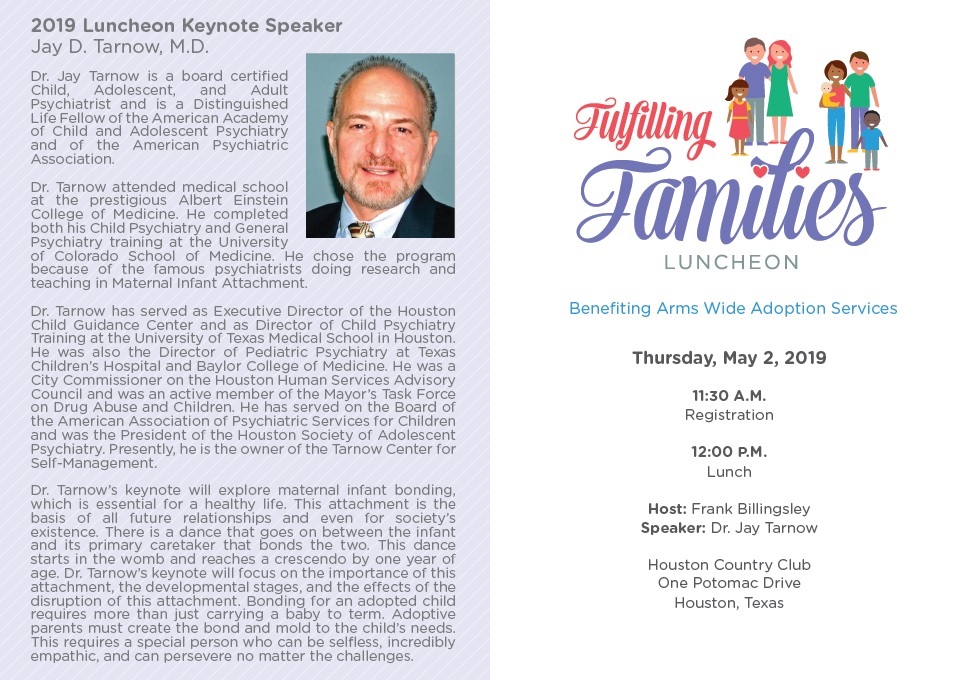
The Tarnow Center for Self-Management is proud to partner with the Houston nonprofit Arms Wide Adoption Services during National Foster Care Appreciation Month this May. Dr. Tarnow will be the keynote speaker at their Fulfilling Families Luncheon on May 2nd, 2019 to expertly speak on attachment, how primary caregivers and infants form this emotional bond, and its implications on the development of personality, future relationships, and society as a whole. Proceeds from this event will help Arms Wide Adoption Services continue its mission to transform the lives of foster children in need of safe and nurturing adoptive families. We hope to see you in May! https://www.armswideadoption.org/annual-luncheon/

Pills

ADDA-SR Workshop featuring Jay Tarnow, MD / Ron Swatzyna, PhD, LCSW

Psychiatry does well in many instances: however there are perplexing cases that do not respond as predicted to the first and even the second medication attempt. Electroencephalography (EEG), quantitative EEG (qEEG) and genome testing provides scientific data that can help to explain the cause of the symptoms, give insight as to why the prior medications failed and gives psychiatrists valuable personalized information as to which medication will most likely work without side-effects. Merging brain mapping technology with psychiatry can maximize treatment results and measure improvement.

A diagnosis of ADHD is made when a person shows a minimum number of specific symptoms. The problem is that ADHD symptoms have many neurological and biological causes and each one is medication specific. Brain mapping technology can identify the cause of the inability to focus and this information helps a psychiatrist pinpoint the exact medication. This event is based on Drs Swatzyna’s and Tarnow’s recently published six-year study that presents the most common brain and body anomalies that create ADHD symptoms and explains how this information can assist in medication selection and treatment.

July 18, 2015
8:30 a.m. - 12:30 p.m.
Memorial Drive United Methodist Church, The Gate at The MDUMC Connection Center
13194 Memorial Drive, Houston, TX 77079, Located in the T.J. Maxx shopping center
To register, please go to the ADDA-SR website (CLICK HERE).

jay_tarnow

Jay D. Tarnow, MD

Often times, parents and caretakers believe that their children, adolescents, or young adults are spending too much time on leisure activities and less on study time. They buy flashcards, join enrichment classes, and attend tutorials with the hopes of improving their grades.  Some college students even begin to stop exercising, biking, swimming, or engaging in outdoor and physical activities that they normally did until they entered college. While this may open up some more time in one’s daily schedule or increase study time, it is important to understand that exercise may actually be linked with better grades!

According to a recent report presented at the American College of Sports Medicines’ 57th annual meeting, college students who exercise vigorously on a regular level have higher G.P.A.’s than those who did not. This report is based on a highly controlled and systematic research study at the Saginaw State University in Michigan that controlled for the number of factors that might influence a student’s G.P.A. Results indicated that students who exercised 7 days a week on an average scored 0.4 points higher on a 4.0 scale than those did not.

An earlier study published in the Medicine and Science in Sports and Exercise also found that the more hours a student spends studying, the greater is the likelihood of them exercising. It was also found that students with G.P.A’s of 3.5 or higher were three times more likely to participate in vigorous physical activities than students with a G.P.A. under 3.0. This suggests that a high academic work ethic may also translate into a higher commitment to exercising.

Other studies on school-age children have also shown that students who did well on tests of muscular fitness, cardiovascular fitness, flexibility, and body composition, scored higher on academic achievement tests. An experiment at an American high school showed that students in literacy classes held immediately following PE class consistently performed better than those in the same classes held later in the day.

How does exercise really help? Exercise allows more blood to flow to the brain. This helps the brain take in more nutrients, increase stamina and energy levels, and keep you more alert. This reduces boredom from studying. Exercise has the power to change your brain for the better by creating new cells, balancing neurotransmitters and improving connections between cells.  Experts recommend that children at school participate in at least one hour of physical activity every day because it improves memory, concentration, and processing speed.

So whether or not you have tests coming up, go hit the gym today. It will not only make you physically active but also mentally alert!!

Pills

With the discontinuation of VayarinTM, many of our patients have been asking us for an alternative non-prescription nutraceutical product to help with cognition and symptoms of ADHD. After exploring all of our options, AccentrateTM is a new product we are endorsing and offering at the Tarnow Center.


This non-stimulant is specifically formulated for the treatment of ADHD in children and adolescents. With active ingredients such as EPA, DHA, B6, B12, D3, magnesium, and methylfolate, AccentrateTM contains a wide variety of vitamins that may help reduce symptoms in those with ADHD and similar neurological disorders. While B6 and B12 help with depression, sleep issues, anxiety, and fatigue, D3 and Magnesium help with energy level and digestion. EPA and DHA are omega-rich fatty acids that may help improve cognition, processing speed, and impulsivity. Methylfolate helps aid in the production of all neurotransmitters, thus increasing positive mood and reducing hyperactivity and impulsivity. Come by the Tarnow Center to discuss AccentrateTM with us today!


https://accentrate.com/