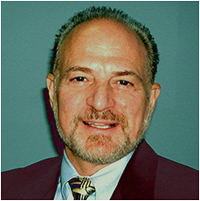
 Jay D. Tarnow, MD
In 1988, I predicted that Managed Care would become the biggest boondoggle in the “industrialization” of Medicine. I blamed the Clintons for handing over the driver’s wheel to the Insurance industry to monitor the healthcare system. What a mistake that was! The people who know the most about health and disease¾the doctors¾ended up with the least amount of power. What we needed were doctors to be involved in the process from the beginning. But, the Clintons did not trust healthcare providers. So, they were literally locked out of the room, as if they were the problem and not the solution. They are trained to heal, not to do business, and this cost the profession dearly. Instead, the Insurance and Managed Care companies were entrusted to bringing about new business practices in the name of saving money. However, this approach backfired as business practices lined the pockets of everyone but the physicians, while the quality and amount of care suffered.
Now, in 2014, we are saddled with a huge bureaucracy of healthcare managers, who are maximizing profits by cutting patient services. Our healthcare delivery is so over-managed that the medications approved to prescribe are constantly changing without the doctors’ awareness. Drugs approved for reimbursement are not the best available, but rather the cheapest ones. Many patients are priced out of a particular treatment and left to try multiple medications that are ineffective for them. This is often due to the insurance company not having negotiated a “special deal” with the pharmaceutical entity, causing the correct medications to be ridiculously expensive. To receive the care they deserve, the patient must pay 50 times more money for an effective drug because of “good business practices” put in place to benefit the insurance company, not the patient.
The 24-hour news cycle, social media, and the contagion of fear
The idea of the Coronavirus is inherently frightening. It is a danger that we cannot see, and there is still a lot to discover about this new threat. The unknowns regarding the Coronavirus often motivate us to seek answers, and, as data pours in, sometimes we are left with more questions. What we do know is that each government is attempting to dampen the damage created by the pandemic. We are asked to listen to Health Care precautions. However, what happens when the information we seek contradicts the news we hear from others? When we receive contradictory information, it often creates confusion. When there is an invisible threat, that confusion can turn into fear. That fear can pass from one person to another quickly. Soon, the spread of a contagious fear has reached enough people, and we have mass panic. The practical course of action is to follow medical advice, which will lessen the likelihood that you or loved one contracts the disease.
Fear at your fingertips
Fear as a response is a normal part of the human condition. It is wired into us; it is a biological response that helps our survival. A clear example of this is the fight/flight response. When we see an imminent danger, our body responds to the threat releasing adrenaline and turning on the Adrenergic Nervous System. However, when we are at this heightened state of alertness, this system and hormones can weaken our ability to make rational decisions. At that moment, we are only thinking about how to overcome that threat. Our senses become incredibly focused but also block out the periphery- "Tunnel Vision." The world around us can shrink, and we can disregard the well-being of others. Instinctually, in the act of self-preservation, we react. The problem is that since this threat is invisible and so many people are afraid, that fear pushes us to seek answers outside anywhere we can get it. We turn to the authorities. Many of us think this comes from the internet or social media. But, fear can quickly be summoned from our fingertips. The 24-hour news cycle and social media worsen our anxiety by providing misguided advice and misinformation. Sometimes the people distributing facts have ulterior motives that can capitalize on fear. When the accessibility of our fear is at our fingertips, we need to remember that we have control even if, at times, it feels like we don't.
Traversing the storm
The 2013-2016 West African Ebola virus taught us that our fear-based responses could worsen a situation. We found that fear-based responses exacerbated the spread of the virus, alienated survivors, and damaged the perception of health care providers among the population. So, at an individual level, we can contribute to the global fight against the pandemic by limiting our exposure to fear. When we are calm and rational, we become less likely to break safety protocol, prevent disease spread, and responsibly manage resources. Just as we take the appropriate precautions to reduce the spread of the Coronavirus, we can reduce the spread of coronavirus fear. Quarantine fear by mirroring the physical quarantine of the virus:
- Restrict or prevent misinformation from entering your home.
- You can do this by identifying sources that provide unhelpful information.
- Unhelpful information is not fact or evidence-based.
- Avoid any news media that tries to sensationalize, catastrophize, or discusses worst-case scenarios.
- Limit online exposure to coronavirus information by avoiding social media or the news.
- Choose how much time you would like to expose yourself to information. Just like you are limiting your exposure to crowds.
- Once a timeframe for news updates is selected, set a routine (for example, check 3x daily for 30 minutes).
- Stay responsibly informed with trusted information and avoid social media (unless it is the CDC).
- Select a few trusted sources of information (i.e., the CDC) when remaining informed.
- Direct references from trusted sources can sort out fact from opinion.
- Selecting trusted sources limits non-professional healthcare opinions.
- Diversify conversation with friends, try not to have every conversation about the Coronavirus.
- Consistent conversation or media exposure about the Coronavirus will increase stress.
- Diversifying conversations can help alleviate stress and provide a feeling of normality—I.e., how to affiliate without endangering ourselves from overexposure.
- Be positive and supportive.
- Fear can trap you in a spiral of assuming the worst outcome will happen.
- Positivity can help navigate the temporary change in our livelihoods.
- Be supportive; your positivity can help others calm their nerves.
When in the grip of fear
Fear can be a powerful force to fight. When in the emotional grasp of fear, life can feel overwhelming and dreadful. The emotional response of fear is subjective and can be accompanied by other negative emotions. Emotionally, the experience of fear is uncomfortable, and it moves us towards avoiding a perceived danger. While in the grasp of fear, the 'tunnel vision' occurs because we are thinking of ways to escape, and we keep thinking of the fear until we can feel safe. The body's response accompanies the emotional response. Our body responds to fear by preparing us for survival. The body increases our heart rate, the muscles tense, we begin to sweat, and we become hypervigilant. We often recognize this when we feel that pit in our stomach, the tension in our shoulders, that heaviness in our chest, or the quick short breaths. Both the emotional and physical symptoms direct us into a particular set of survival behaviors. Often, these behaviors can be irrational and disproportional to the situation. For example, buying exorbitant amounts of toilet paper, hand sanitizer, or face masks were behaviors that were driven by the fear of the unknown. In hindsight, those behaviors perpetuated panic and let few supplies for people that needed them.
Wrestling from the grips of fear
It is understandable if you're afraid. Maybe you've been oversaturated with Coronavirus news, social media, or conversation. If you're feeling 'burnt out' with the consistent coronavirus coverage, there is help. First, if you identify with the emotion and physical symptoms of fear, you are not alone. These symptoms can be surprising. Maybe you were experiencing anxiety or negative emotions prior to the outbreak. The added stress of a pandemic, job security, and safety can create a heavy emotional burden. Second, maybe you've recognized a strange pattern in behaviors developing since the start of the pandemic. Have the patterns caused you to make rash financial or emotional decisions? Have you extremely isolated yourself? Are you obsessively reaching out to loved ones? If so, these behaviors are a response to fear, and some can be destructive. To regain a sense of clarity for a rational response to this pandemic, here are a few suggestions:
- Take the time to breath
- Take a deep breath, in through your nose, out through your mouth (four seconds in, four seconds out, for 10-15 minutes, as needed throughout the day).
- This will help regulate your breathing, reducing that feeling of panic and alleviating some tension in the shoulders.
- Be sure to do this in a peaceful environment. Relaxing music can help.
- Meditate
- Create a peaceful space. No distractions. Turn off all media that does not help with peace.
- Find a mantra or use guided media that coincides with your religious or spiritual beliefs.
- Combine deep breathing for added effect.
- Best practice is at least once a day, for 10-15 minutes.
- Exercise
- Select bodyweight exercises that you can do (i.e., push-ups, air squats, walk, etc.)
- Start modestly; you have no one to impress; this is for you (do for 20-30 minutes daily or as a physician recommends).
- Be consistent, set a routine and stay within your physical limits.
- Seek social support
- Hang out with a friend or family member, if physically separated, a phone call or teleconference can help.
- Adhere to the six feet rule if in public.
- Avoid talking about the Coronavirus.
- Build or re-build intimacy
- Spend time with loved ones. The time you spend out of work or school can be repurposed to improving familial relationships.
- Engage in encouraging conversation and allow for opportunities of emotional vulnerability.
- Listen and be compassionate to another person’s worries.
- Forgive is you are at an emotional place to do so.
- Play games with each other.
- Have fun.
- Seek spiritual or religious support from your Higher Power
- Pray, the free time can be a wonderful opportunity for you to connect or re-connect to your beliefs or values.
- Watch online sermons or church services.
- Read books about your beliefs.
Remember, fear is a natural response. Understandably, you are afraid. The threat is invisible. However, adhering to medical precautions will reduce the likelihood that you would contract the disease. Psychological self-care will help to alleviate the fear. If you believe the fear is overwhelming, seek the help of a counselor, psychologist, or psychiatrist. There are tele-mental health options available. A tele-mental health option may be appropriate during a pandemic. During a tele-mental health session, the meeting is digital, and there is no need for an in-person visit. The digital method can help with adhering to social distancing and prevent the spread of germs due to the lack of physical proximity. Stay safe by limiting your exposure to the virus and fear. Help can be found at the Tarnow Center for Self-Management.

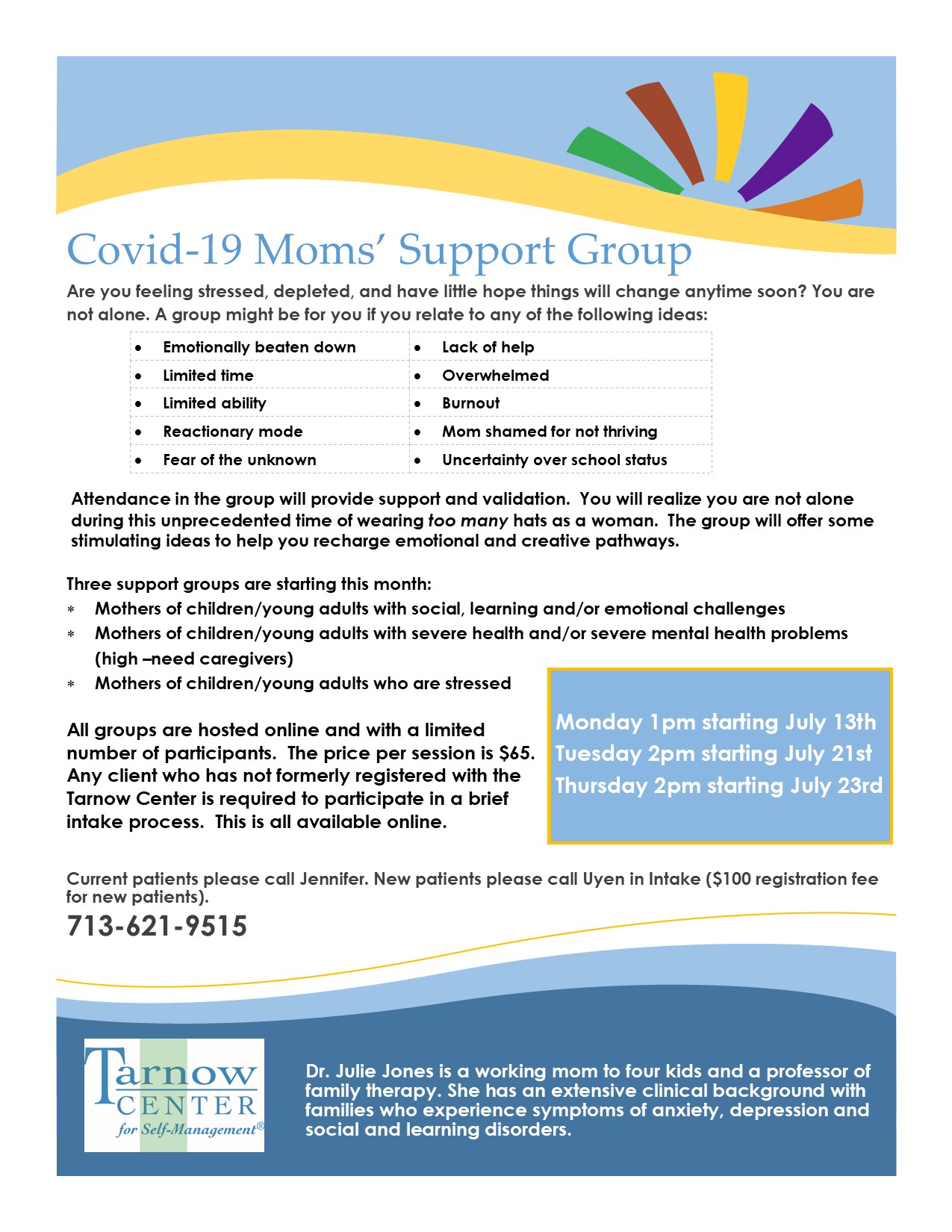
Are you or any moms you know struggling right now? Recently the number of overwhelmed mothers I am talking to is rising. I believe moms are carrying a lot right now and many are very concerned about the future. In the age of COVID-19, moms have little ability to escape overwhelming responsibilities. If you or anyone you know might feel the need to connect to others in a supportive group, please feel free to contact my office. A document is attached with more details, including groups for moms of special needs kids/young adults.
Julie Jones, PhD, LMFT-S, LPC-S
Desireé Gallagher, Psy.D.

Mindfulness is a practice that focuses on building awareness of the present by utilizing various senses and building self-soothing techniques. A primary goal is to increase awareness of thoughts, behaviors, and body sensations. Mindfulness has a basis in meditation and has been used in the treatment of emotional difficulties with adults for a long period. Stressors and suffering are inevitable. Mindfulness demonstrates techniques to cope with life’s challenges.
Recently, research has focused on establishing an effective treatment of mindfulness for children and adolescents. Mindfulness skills have been demonstrated to be effective at decreasing anxiety and stress in school-aged children. There is increasing evidence that mindfulness-based therapy can decrease impulsivity and hyperactivity and increase attention and self-esteem.
Mindfulness-based group uses activities and stories which are a focus of teaching and practicing the skills. Research demonstrates that children taught mindfulness-based skills show reductions in emotional and behavioral problems and improved academic functioning. Goals include building awareness of thoughts, feelings, and sensations. A mindfulness-based group of 12 weekly sessions for ages 8-12 will be available during the Spring and Summer 2013. Call Dr. Gallagher at 713-621-9515 or email This email address is being protected from spambots. You need JavaScript enabled to view it. to reserve a space. Dr. Gallagher is a Child Psychologist at the Tarnow Center and sees patients in Houston and Sugar Land.
 Lynn Ayres, M.Ed.
Everyone has a unique learning profile of strengths and weaknesses which impacts his/her success and performance in school and beyond. Some learning profiles are labeled negatively while others are highly regarded. Students with challenging learning profiles can spend a lot of time blaming themselves for being lazy or stupid, or somehow responsible for what is really nothing more than a variation in brain wiring.
Once a person understands what their learning profile is, they can make conscious choices that will let them learn effectively. Imagine trying to run across a boulder strewn field blindfolded. You might make it to the other side, but it’s going to entail a lot of pain. Now imagine taking the blindfold off. The boulders are still there, but when you can see them, you can avoid them.
The Tarnow Center Neurodevelopmental Assessment is a six-hour evaluation for students aged three to eighteen. It is a way for students to take the blindfold off and find out what their strengths and weaknesses are in learning situations.
The Neurodevelopmental Assessment includes an evaluation of cognitive skills, processing skills, neurodevelopmental systems, and achievement. Each of the brain functions that can affect a student’s learning and performance are evaluated. This includes memory, language, attention, and the ability to organize information. The evaluation also assesses neuromotor functions (fine and gross-motor skills), as well as social cognition and higher order cognition (problem solving, thinking critically, and reasoning skills).
The neurodevelopmental profile of strengths, weaknesses, and interests are linked to a student’s academic skills and performance.
Through learning how his/her brain is wired, a student is given helpful strategies and methods so he/she can become a more productive learner. Suggestions for accommodations are made, as well as activities designed to strengthen an area of weakness as well as strength.
Perhaps most important is that the Neurodevelopmental Assessment makes visible what was once hidden, and when students can understand where the obstacles to success are, it is much easier to compensate and manage them. This is a much more productive strategy than taking on the label of dumb, lazy or stubborn.
The Neurodevelopmental Assessment is based on the ground-breaking work of Dr. Mel Levine. For over 30 years, Dr. Levine, a developmental pediatrician, author, and professor has pioneered programs for the evaluation of children and young adults with learning, developmental, and/or behavioral problems. He has been instrumental in developing an innovative and dynamic assessment model that helps students and families understand why they are struggling, and provides tools to help them succeed in school and ultimately, in life.