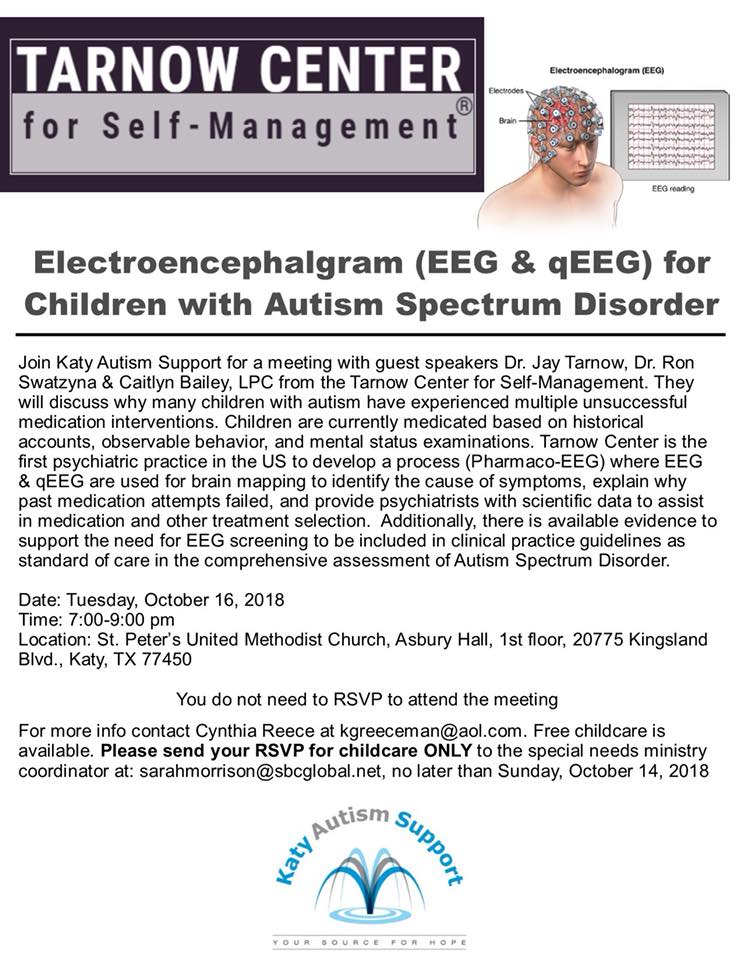
Katy Autism Support and Dr. Tarnow, Dr. Swatzyna, and Caitlin Bailey from the Tarnow Center for Self-Management are joining together to host a meeting on Tuesday October 16.
The discussion will be about why many children diagnosed with Autism Spectrum Disorder have experienced multiple unsuccessful medication interventions and what technology can be used to prevent this from happening in the future.
See the flyer below for more information.

Children with ADHD commonly experience sleep problems. Past studies indicate 70-85% of children with ADHD have sleep problems. In some of these cases, the significant sleep difficulties the children are experiencing are contributing to the symptoms and could even lead to the child being misdiagnosed. In other cases, sleep problems co-exist with ADHD and contribute to functional impairment.
Although the association between sleep difficulties and the ADHD diagnoses is well known, sleep difficulties are not regularly evaluated during an ADHD assessment. Going along with the American Academy of Pediatrics assessment recommendation, assessing a child’s sleep difficulties should be a part of the treatment plan.
Following this idea, a new study on the relationship between ADHD and sleep difficulties in children found that sleep difficulties often impair a child’s daily functioning in ways independent of ADHD symptoms themselves.
The study consisted of 192 children with a mean age of 10 who had been carefully diagnosed with ADHD. The participants were measured on scales regarding their sleep behaviors, ADHD symptoms, and their daily functioning. The results found that the most prevalent sleep problem, excessive daytime sleepiness, was reported in 42% of the children.
In addition, 30% had insomnia, 26% had periodic limb movements (PLMS), and 25% had a sleep-related breathing disorder (SRBD).
Analysis of the data indicated that sleep problems – especially excessive daytime sleepiness – significantly contributed to lower daily functioning skills even after ADHD symptoms were controlled. Higher levels of insomnia predicted increased social impairment – beyond the impairment explainable by ADHD symptoms.
This research highlights the need to assess children with ADHD for sleep difficulties, and to treat these difficulties if and when they are identified. Although ADHD symptoms can impair a child’s functioning in many ways, parents, educators and clinicians should not attribute all the child’s difficulties to ADHD before potential sleep difficulties are examined.
The following post is based on the research article “The Functional Impact of Sleep Disorders in Children with ADHD” published in the Journal of Attention Disorders. For more information the article abstract can be found on PubMed.
Have you experienced fatigue, stress, or depression without being able to pinpoint the cause? Have you considered that food could be linked to your symptoms? Have traditional blood and allergy tests failed to identify anything wrong?
At the Tarnow Center, we focus on individualized treatment plans and strive to develop an all-encompassing, holistic approach to wellness for each client. We understand the importance of nutrition and recognize that each person has different dietary needs. Recently, parents have expressed interest in nutritional testing for their children, and we have responded by offering one of the largest and most-trusted food intolerance tests in the country. The Alcat Test is a simple blood test that measures a client’s sensitivity levels to 420 foods, medicinal herbs, food additives and colorings, environmental chemicals, molds, and antibiotics. Unlike traditional allergy tests, the Alcat Test reveals clinically significant reactions that don’t fall within the conventional definition of “allergy.” Food intolerance is much more common than a true food allergy, and although intolerance can produce equally harmful symptoms, traditional allergy tests do not report food intolerances. Many people with no evidence of food allergies have significant Alcat results.
Understanding and identifying food sensitivities is absolutely essential in treating underlying causes of diseases. Inflammation and chronic activation of the immune system due to food intolerance has been linked to digestive disorders, migraines, obesity, chronic fatigue, learning disabilities, ASD, ADHD, aching joints, skin disorders, and several other health conditions.
Individualized testing will help you or your child be proactive, instead of reactive, to certain health conditions. Instead of taking medicine to alleviate digestive symptoms, the Alcat Test provides you with an opportunity to understand why those symptoms exist in the first place. Ingesting a food that your body cannot tolerate will cause internal inflammation that may lead to chronic diseases later in life. The Alcat Test is essential for those experiencing stress, fatigue, depression, and other symptoms that have not been explained by any other allergy or blood tests. If you eat healthy but still feel tired and drained, it’s time to take a look at what your body is reacting to. One man’s food is another man’s poison, and unfortunately, many people have internal reactions to foods that are considered healthy.
Food intolerance testing can provide the information necessary to help clients manage existing health problems and promote optimal health. Appropriate for all ages, the Alcat Test is a vital step in identifying food sensitivities and reducing symptoms before they become permanent. The human body is extremely complex, and an individualized wellness approach is the only way to guarantee the best results. Knowledge about your food intolerances is vital to promote a healthy body and healthy mind.
SHAME... Say the world aloud a couple of times and check in compassionately with how you are feeling. What do you notice in your body? What sensations can you identify? What about your thoughts- do any memories, images, or words come up for you? Isn't it remarkable how simply saying a word aloud can create such a visceral and immediate reaction in ourselves? This reality speaks to the unrelenting power of our universally shared fear of disconnection, of our worry that we are flawed and fallible and therefore unworthy of love, belonging, and connection. Yes, shame inevitably enters into our lives early on and it tends to settle into our bones undeterred and often tragically unexplored.
This process comes with the territory of being human. It happens to everyone, and yet not surprisingly, we don't tend to talk about it. To be sure, shame loves this reality because, as Dr. Brené Brown reports, shame requires secrecy, silence, and judgment in order to survive and to spread. The breeding ground for shame in our competition-driven and scarcity based culture are ripe as we are bombarded with consistent messages that we are "not enough" at every turn. Just taking a look at our advertising world and how it both creates and reinforces personal insecurities, we also see how shame exists as a social epidemic affecting the masses. As a collective, we fall into a constant comparison trap that renders us feeling "less than" given the unrealistic and unattainable ideals of perfection and of our fantastical ideas of how great other people (who are not like us) have it. In the end, we do not measure up and we are at risk of being plagued with an irrefutable sense that we are unlovable and we don't belong. We then slip into living outside of our values, which quickly leads to life feeling pretty miserable, if not empty or completely unmanageable.
This is startling news. Moreover, suicide rates have been rising, divorce rates continue to linger around 50%, and nearly 1 in 5 Americans suffers from mental illness each year. Respecting that shame strips us of our courage and fosters disengagement and further disconnection, we have an imperative to act and to provide safe opportunities for people to begin learning more about how shame exists and operates in our lives. To be sure, developing a resiliency to shame affords us all the opportunity to reconnect to our sense of worthiness and of "being enough" as we are. From this space, relationships improve, vitality is restored, and joy becomes possible as connection engenders greater intimacy, courage, vulnerability, and authenticity among people.
Thankfully, there is good news! Dr. Brené Brown, who is a research professor here in our backyard at the University of Houston Graduate College of Social Work, has spent the past 14 years studying shame and connection and her valuable work is now available to us. Dr. Brown is the author of the #1 New York Times bestseller Daring Greatly: How the Courage to Be Vulnerable Transforms the Way We Live, Love, Parent, and Lead (2012), the New York Times bestseller The Gifts of Imperfection (2010), and I Thought it Was Just Me (2007).
If you have not yet viewed her TED Talks on shame and vulnerability, I highly recommend checking them out.
You can also learn more about Dr. Brown by visiting www.brenebrown.com or www.thedaringway.com.
I believe what she offers can and does transform lives. If you are inspired by what you hear, I warmly invite you to consider engaging in your own shame resiliency and authenticity work, either through individual sessions or by participating in one of the 8 week Daring Way™ groups.
Recent reports indicate that insomnia is very common and occurs in approximately 30-60 percent of the general population. The DSM-IV-R defines insomnia as having problems with initiating and/or maintaining sleep, despite adequate opportunity and time to sleep, leading to impaired daytime functioning. Many individuals today have one or more sleep complaints, which include problems falling asleep, problems staying asleep or falling back to sleep after waking, waking early, and excessive daytime sleepiness.
When people come to see me about sleep problems, my first thought is towards sleep hygiene. Sleep hygiene involves several things, including a structured bedtime routine. Listed below are ten recommendations for improving the quality of your sleep:
- When you feel rested get out of bed. Oversleeping will disrupt the circadian rhythm and actually make you feel more tired than refreshed.
- Maintain a regular sleep schedule, and avoid napping during the day. This involves doing the same things to get ready for bed, and going to sleep at the same time every night.
- Refrain from drinking caffeine or smoking in the evening as these activities stimulate the areas in your brain that are associated with arousal and wakefulness.
- Refrain from drinking alcohol in the evening. Although alcohol initially makes you tired and relaxed, it also causes withdrawal symptoms when it leaves the body, resulting in frequent awakenings and poor, fragmented sleep.
- Exercise regularly, but not 4-5 hours before bed. Exercise initially raises body temperature, but after 3-6 hours, there is a compensatory drop in temperature that maximizes drowsiness. Keeping your room at a cooler temperature will also help to make you tired.
- Use the bed only for sleep, and not for working, reading, watching TV, eating, or other mentally stimulating activities. Even if the TV is on while you sleep, your brain is still working to decode what is happening.
- Go to bed only when you feel ready to sleep. Sleepiness is signaled by behaviors such as drooping eyelids, involuntary nodding, and yawning.
- Turn off the lights and all the noise in and around the bedroom. A quiet atmosphere will help you to relax more quickly and improve the quality of your sleep. Another helpful hint is to turn the clock away from you so that you cannot see it.
- Get up at the same time very morning, even on the weekends. This helps to keep your body on a regular schedule. Don’t worry if you don’t sleep well one night, because the drive to sleep will be higher the following night.
- If you do not fall asleep within 20 minutes after lying down, get up and try some relaxation techniques until you are ready to sleep again. Staying in bed only during sleep strengthens the association between your bed and sleeping. Instead of associating your bed with being awake, you associate your bed with being sleepy, and eventually, lying in bed will cause you to be tired, even if you weren't tired beforehand.
- Relaxation techniques are a great way to relieve stress, and involve sitting or lying comfortably and relaxing muscles of the body in one area at time. This may be combined with biofeedback and deep breathing to promote further body relaxation.
Another evidenced-based, non-medical, behavior therapy for insomnia is called sleep restriction. Sleep restriction is based on the principle that reducing the time you spend in bed helps to solidify sleep. It creates a mild state of sleep deprivation that makes it easier to fall asleep and stay asleep. At first, clients are asked to record both the total time they spend in bed and the proportion of the time they spend sleeping. The next step is to limit the time you spend in bed to only the time that you spend sleeping. For example, a person who spends 8 hours in bed and only sleeps for 5 hours would be told to decrease the amount of time they spend in bed to 5 hours. Gradually, sleep time is increased by 15-20 minute increments until the client reaches his or her optimum sleep time.
Good sleep hygiene and other behavioral sleep interventions are an essential part in treating insomnia and other sleep problems, and better sleep leads to better daytime functioning. Contact me or the Tarnow Center for more information on self-management skills for initiating and maintaining quality sleep. The Tarnow Center has clinicians who specialize in Adult Psychiatry, Adolescent Psychiatry, Child Psychiatry, Adult Psychology, Adolescent Psychology, and Child Psychology in Houston and Sugar Land.