Sophia K. Havasy, Ph.D.

In my work with older adolescents and young adults, the question, "Why are these kids so complicated?" usually comes to me from parents in unspoken form. The parents have done everything. The child has been evaluated, diagnosed, medicated. He has attended special schools; she has had special tutors. Behavioral plans have been instituted at home and at school. "What's next? When will we be done?" they ask. I talk with them about 10-year plans as development is delayed and the brain is not fully developed until the mid-twenties. We discuss the limits of psychiatry and psychology as diagnosticc categories only give us a gross understanding of each particular child. Labels and diagnoses, in and of themselves, do not always tell us much. It becomes more important with young adults to understand each family's patterns of interactions and accommodations in order to support an effective launching plan. I tell parents, "The young adult can't do it without you."
Treatment with older teenagers and young adults with self-management disorders is about getting to know each young person, his or her family, and how they function, both individually and together. There is no "one size fits all" for the high school or college student with ADHD, Tourette's, learning disabilities, anxiety or depression--to name just a few. For example, the usual approaches to SAT/ACT preparation can be confusing, overwhelming, and defeating for the vulnerable teenager with ADHD or learning differences. That student may respond much better to working with someone who understands her learning strengths and weaknesses, as well as, how anxiety can derail her best cognitive skills on any given day.
Launching these complicated young people is not a generic process. It must become individualized in order to increase the potential for the incremental successes that keep the student and family going. Movement towards successful outcomes, such as a Bachelor's degree or vocational certifications, may seem glacial. Families can get discouraged when their young person is compared to friends, siblings, or cousins. The traumatic impact on these same students, however, of major failures, such as DWI's or Academic Probation, can add years to the launching process. It is a difficult, and sometimes, devastating process for the family of a failed student to pick him up and start over, sometimes, again and again. The toll on self-esteem, confidence, and courage to try again can make it all feel insurmountable to a vulnerable young adult.
The key to successful launching of young people with self-management disorders is to get them, and then keep them, engaged in their own growth as much as possible. This sounds easier than it is. It is also not linear. There are stops and starts, detours and road blocks. It is painful to observe a young adult who is stalled out with no movement in any direction. Parents in response tend to get fearful and frustrated which seems to immobilize the young adult even more.
Parents must believe in growth. They must believe that their young person can learn to make their way in the world. The developmental process and neuroplasticity are the family's main allies for growth, but they are not passive processes. Things to remember: 1) The brain learns. Learning is what builds a brain. 2) The brain grows new pathways in struggle; skills emerge out of active engagement. No learning occurs if a task is too easy or too hard. For each of us, it is about finding that optimal level of frustration with a task being just too hard, and then, figuring it out. Over and over again.
When children are young it can be easier to encourage growth. Their friends know how to swim or ride a bike. Parents say "You can have swimming lessons." Or, "We will teach you how to ride a bike." Your child does not want to get left behind. As children get older they are often very aware of what peers are able to do and they, themselves, can't. Parents may get tired of hearing what Annie gets to do, but at the same time, there is awareness that kids encourage each other's growth.
When vulnerable teenagers and young adults get stalled or derailed from their own growth path, it can be very difficult for parents to get them moving again in a good direction. It is an individualized process. The neurological differences which are subsumed under various diagnoses, interfere in ways that are hard to comprehend and make sense of by parents and even some mental health professionals. The goals for launching may be the same for your vulnerable young adult as it is for any of your other children. The path, the route may look much different. This is where parents need special help to get the young person engaged in growth.
A dear friend wrote to me and said, "Thanks for understanding, but how are you going to help me to help my child? I feel helpless and hopeless. I've done so much and here we are coping with another huge hurdle. The hurdles get bigger and bigger and never seem to end."
We start with opening up a dialogue. The parents are going through various stages of grief all the time. They need to be able to express their fears, resentments, sadness, and frustrations without the young person taking it on and feeling miserable, and without the parents feeling guilty or blaming each other. The family is living in a complicated launching process that no one planned or wanted. Each family member feels blamed, responsible, and stuck. This is where a therapist, experienced with these types of young people, is useful.
Meeting separately with parents and the young adult or teenager, the therapist begins to get a clearer sense of the family and where the work is. Learning Style, Self-Management, and Psychological Evaluations help to clarify how the young adult's brain processes information, where the self-managment skills are in place, and what needs to be developed. At the same time, the parents engage in a process of determining what they will and will not support, what is involved or required to live in their home, and what they will and will not pay for. We work together to distinguish between enabling and supporting the young person. Enabling is when the actions of others interfere with an individual experiencing the consequences of his or her actions. This sounds simple enough until the young person gets in trouble and looks to be rescued. Families feel the pull to rescue quite intensely, and sometimes, they should rescue. But, there is always a price to pay. It is a highly individualized process. There is no one way to do this!
The next step comes when the teenager and parents comprehend that growth is not about good intentions alone. The good intentions must become operationalized in daily life. It is not enough for the young person to say, "I want to get good grades." The intention must be partnered with hard work and persistent effort-by the student, not the parents. Teens will tell you they are ready to go away to college. If, during their senior year of high school, parents have to get them up and moving each day, monitor their medicines, track their tests and projects, then it is clear that they are not ready to leave home. Parents must help these young people appreciate how acquiring and implementing self-management skills at age-appropriate levels are in their best interest. The young people must be engaged in their own growth. But 20 years of experience has taught us that the vulnerable young adult can not do it without you.
In my work with older adolescents and young adults, the question, "Why are these kids so complicated?" usually comes to me from parents in unspoken form. The parents have done everything. The child has been evaluated, diagnosed, medicated. He has attended special schools; she has had special tutors. Behavioral plans have been instituted at home and at school. "What's next? When will we be done?" they ask. I talk with them about 10-year plans as development is delayed and the brain is not fully developed until the mid-twenties. We discuss the limits of psychiatry and psychology as diagnosticc categories only give us a gross understanding of each particular child. Labels and diagnoses, in and of themselves, do not always tell us much. It becomes more important with young adults to understand each family's patterns of interactions and accommodations in order to support an effective launching plan. I tell parents, "The young adult can't do it without you."
Treatment with older teenagers and young adults with self-management disorders is about getting to know each young person, his or her family, and how they function, both individually and together. There is no "one size fits all" for the high school or college student with ADHD, Tourette's, learning disabilities, anxiety or depression--to name just a few. For example, the usual approaches to SAT/ACT preparation can be confusing, overwhelming, and defeating for the vulnerable teenager with ADHD or learning differences. That student may respond much better to working with someone who understands her learning strengths and weaknesses, as well as, how anxiety can derail her best cognitive skills on any given day.
Launching these complicated young people is not a generic process. It must become individualized in order to increase the potential for the incremental successes that keep the student and family going. Movement towards successful outcomes, such as a Bachelor's degree or vocational certifications, may seem glacial. Families can get discouraged when their young person is compared to friends, siblings, or cousins. The traumatic impact on these same students, however, of major failures, such as DWI's or Academic Probation, can add years to the launching process. It is a difficult, and sometimes, devastating process for the family of a failed student to pick him up and start over, sometimes, again and again. The toll on self-esteem, confidence, and courage to try again can make it all feel insurmountable to a vulnerable young adult.
The key to successful launching of young people with self-management disorders is to get them, and then keep them, engaged in their own growth as much as possible. This sounds easier than it is. It is also not linear. There are stops and starts, detours and road blocks. It is painful to observe a young adult who is stalled out with no movement in any direction. Parents in response tend to get fearful and frustrated which seems to immobilize the young adult even more.
Parents must believe in growth. They must believe that their young person can learn to make their way in the world. The developmental process and neuroplasticity are the family's main allies for growth, but they are not passive processes. Things to remember: 1) The brain learns. Learning is what builds a brain. 2) The brain grows new pathways in struggle; skills emerge out of active engagement. No learning occurs if a task is too easy or too hard. For each of us, it is about finding that optimal level of frustration with a task being just too hard, and then, figuring it out. Over and over again.
When children are young it can be easier to encourage growth. Their friends know how to swim or ride a bike. Parents say "You can have swimming lessons." Or, "We will teach you how to ride a bike." Your child does not want to get left behind. As children get older they are often very aware of what peers are able to do and they, themselves, can't. Parents may get tired of hearing what Annie gets to do, but at the same time, there is awareness that kids encourage each other's growth.
When vulnerable teenagers and young adults get stalled or derailed from their own growth path, it can be very difficult for parents to get them moving again in a good direction. It is an individualized process. The neurological differences which are subsumed under various diagnoses, interfere in ways that are hard to comprehend and make sense of by parents and even some mental health professionals. The goals for launching may be the same for your vulnerable young adult as it is for any of your other children. The path, the route may look much different. This is where parents need special help to get the young person engaged in growth.
A dear friend wrote to me and said, "Thanks for understanding, but how are you going to help me to help my child? I feel helpless and hopeless. I've done so much and here we are coping with another huge hurdle. The hurdles get bigger and bigger and never seem to end."
We start with opening up a dialogue. The parents are going through various stages of grief all the time. They need to be able to express their fears, resentments, sadness, and frustrations without the young person taking it on and feeling miserable, and without the parents feeling guilty or blaming each other. The family is living in a complicated launching process that no one planned or wanted. Each family member feels blamed, responsible, and stuck. This is where a therapist, experienced with these types of young people, is useful.
Meeting separately with parents and the young adult or teenager, the therapist begins to get a clearer sense of the family and where the work is. Learning Style, Self-Management, and Psychological Evaluations help to clarify how the young adult's brain processes information, where the self-managment skills are in place, and what needs to be developed. At the same time, the parents engage in a process of determining what they will and will not support, what is involved or required to live in their home, and what they will and will not pay for. We work together to distinguish between enabling and supporting the young person. Enabling is when the actions of others interfere with an individual experiencing the consequences of his or her actions. This sounds simple enough until the young person gets in trouble and looks to be rescued. Families feel the pull to rescue quite intensely, and sometimes, they should rescue. But, there is always a price to pay. It is a highly individualized process. There is no one way to do this!
The next step comes when the teenager and parents comprehend that growth is not about good intentions alone. The good intentions must become operationalized in daily life. It is not enough for the young person to say, "I want to get good grades." The intention must be partnered with hard work and persistent effort-by the student, not the parents. Teens will tell you they are ready to go away to college. If, during their senior year of high school, parents have to get them up and moving each day, monitor their medicines, track their tests and projects, then it is clear that they are not ready to leave home. Parents must help these young people appreciate how acquiring and implementing self-management skills at age-appropriate levels are in their best interest. The young people must be engaged in their own growth. But 20 years of experience has taught us that the vulnerable young adult can not do it without you.
Attention Deficit Hyperactive Disorder, or ADHD, is a condition that plays a prominent role in a child’s development. According to the Center of Disease Control, roughly 11% of children age 4-17 in the United States are diagnosed with ADHD. However, regardless of its prevalence in our homes and our communities, ADHD is consistently undertreated by Pediatricians and other health specialists.
To diagnose and treat ADHD, doctors refer to the Diagnostic and Statistical Manual, Vol. 5 (DSM-V), a standard classification of mental disorders published by the American Psychiatric Association. According to the DSM-V, ADHD should be properly managed with a combined approach of medicine and behavioral therapy. Yet despite this recommendation, a recent study found that 93.4% of patients with ADHD were treated with medication, but only 13.0% were also receiving behavioral therapy. This study, published in the Journal of the American Academy of Pediatrics, sheds some light on the some of the resources Pediatricians are missing and reasons why your children might not be getting all the care they need.
One of the many important resources needed to diagnose ADHD is a rating scale provided by both the child’s parents and teachers. These ratings provide the doctors with general idea of the severity of the child’s ADHD in multiple settings. This study found that Pediatricians used parent ratings and teacher ratings only 56.7% and 55.5% of the time, respectively. Another equally important asset to managing ADHD is the DSM-V itself. This research found that Pediatricians participating in ADHD management recorded using the DSM-V criteria for ADHD only 70.4% of the time.
Why is this occurring? I firmly believe Pediatricians are highly trained professionals who truly want what’s best for your child. However, current stressors of insurance and the medical field in general have made it difficult for Pediatricians to provide the focus and quality of care their patients deserve. Part of this could be due to time constraints. Due to the ever changing status of medical insurances and reimbursements, doctors now have to see more and more patients to maintain their practice. Therefore, the more patients that need to be seen, a smaller amount of time is allotted for each patient. Even now in medical schools, students are trained to gather patient histories, make an accurate diagnosis, create a treatment plan, and record it all in only 15 minutes. For some conditions, such as a runny nose or sore throat, 15 minutes is adequate amount of time. However, ADHD is a complicated, intricate condition that can have a variety of different symptoms presenting at different stages of childhood. Long story short, 15 minutes is not an appropriate amount of time to spend diagnosing and treating ADHD.
The type of practice can also determine access to psychosocial therapy. In this study, academic practices were compared to non-academic practices, and found that academic practices had a lower percentage of patients undergo psychosocial treatment. This may be attributed to the habit of academic pediatricians referring patients to professionals within their affiliated medical center, which may have longer waiting period to for appointments compared to unaffiliated practices.
Unless the right resources are utilized for diagnoses and treatment, your child’s ADHD may not be adequately managed. If you have concerns that your child’s ADHD is not being treated appropriately, or would like to know more information regarding the resources needed to diagnose ADHD, please contact the Tarnow Center.
Jay Tarnow, MD

Hi everyone,
When I last communicated with you about teaching and learning as we are trying to be everything to everyone, I suggested that we simply do the best we can.
However, this is a good time to help our students develop skills that will last a lifetime. Rather than concentrating on curriculum, we should be focusing on creating a more efficient brain that will lead to more successful learning. With that in mind, I would like to share the summary of a webinar provided by Scientific Learning and Dr. Martha S. Burns, Director of Neuroscience Education, describing a program which has helped so many of the students I have worked with.
Here is the summary of the webinar.
If you are a middle school or high school teacher, this might sound familiar to you. Students who struggle to learn at a normal rate fall behind the average student in school. They often hide their embarrassment behind coping mechanisms such as behavioral issues and are afraid to ask their parents or teachers for help. These learning roadblocks follow them to secondary school, creating a domino effect that leads to low self-esteem, low graduation rates, and more limited career options.
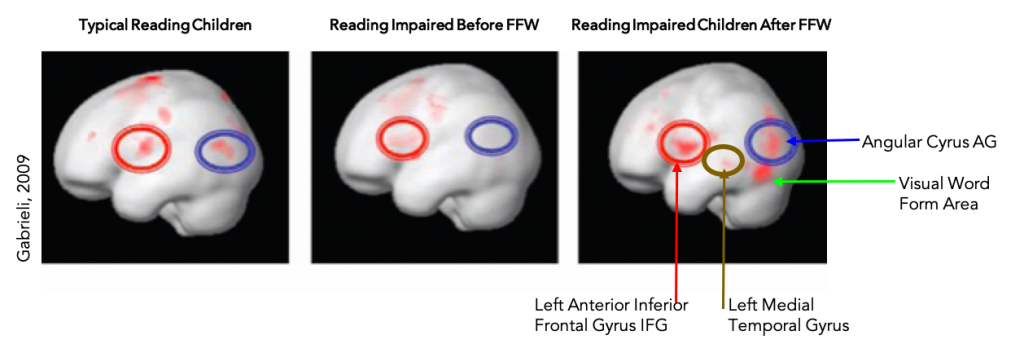
Teachers can become frustrated with their students and may believe that change in behavior is the proper solution to the problem, but it is actually much deeper than that. Neuroscience research has shown that the visual cortex and the auditory cortex do not innately work together, but instead they must be wired together to allow the brain to rapidly and accurately process visual and auditory information. This synchronous wiring allows individuals to automatically associate sounds and letters together, allowing students to decode and comprehend sentences. For some students, the wiring is incomplete, and reading becomes a struggle.
Fortunately, there is research that proves instruction can be engineered to build new abilities within students’ brains as well as trigger brain activity consistent with that of expert readers. In fact, a study at Stanford found struggling students’ brains became normalized after just eight weeks of using the Fast ForWord program, and that the program improved students’ levels of fluency and phonological performance.
The world has been forced to face a new reality; a reality that has caused loss, change, confusion, hurt, and death. The COVID-19 pandemic is forcing us to change in ways we never have previously considered. While attempting to adjust, parents face scary decisions in order to keep their children safe. The decision to have your child attend school or continue on with distance learning is not one that comes easily. How are they affected socially? Are schools prepared? How should parents handle distance learning? So, we are forced to consider all of the impacts your decision for your child may have.
While children attend regular schooling, the academics are not the only crucial impact. There is a major social component to the in-person attendance of school. School routines help keep children anchored. The structure of a routine helps in the brain formation as they develop into responsible adolescents. The rhythm of having attending school, mingling with classmates, and getting a solid education prevents the regression and worsening of psychiatric symptoms. Socialization is the building blocks of skill development in children. Socialization works to combat loneliness and works as a buffer from stress and depression. Humans are social animals- we require human contact to become indoctrinated with the rules and skill to belong to this tribe.
Furthermore, much of the student bodies around the country must have special considerations for their children with disabilities. These children are more susceptible to the harm distance learning has the potential to create. When you consider students with Autism, a social disorder that requires social relations for progress, socialization IS the therapy. Attending school helps children with Autism learn the nuances of social skills. Their need for routine is essential to prevent anxiety, while socialization works towards language development. ADHD and other learning disorders rely tremendously on structure, routine, and rhythm. Engagement in the classroom is vital in their efforts to learn; human interaction is what increases their engagement. Learning disorders have a deep need for stimulation, and without it children will become impulsive, provocative, and argumentative. Children with psychiatric disorders are at risk of becoming very vulnerable. Research in China and Korea has shown worsening symptoms of disorders due to the quarantine procedures.
For the developmental stages children encounter, attending school is very important. Of course attending school in person is not an option for every student; so, distance learning must be done correctly. For the milestone grades that are considered significantly harder (6th grade and up) distance learning can seem torturous in their intimate learning. School is such a vital part of students’ lives. Rates of violence in homes have increased, due to children not being in school. Teachers are our frontline in recognizing violence in the home, so how do we monitor this now? The change in our lives is forcing us to adapt and develop skills that we have not ever had to practice before. The standards become immensely confusing for both the student and the school staff.
So, how can you be sure you’re making the correct decision? First, consider any special health conditions your child has and also health issues in your home. If attending school will compromise their health or someone’s health in your family, consider ways to stimulate their socialization while still attending school at home. Do you visit grandparents or at-risk family members often? Implementing a two-week quarantine before seeing those susceptible to the illness is a way to be sure you keep your loved ones safe, should you chose to send your child to school. Determine any special needs your child may have and how this decision will affect their health, well being, or developmental needs. These all combine to contribute to their livelihood, and should be taken seriously. Research should be done independently to check your city’s local rate of COVID-19.
Additionally, what plans have your child’s school made? Each school should have a contingency plan should someone in the class get sick. Appropriate distancing must be enforced in all areas of the school; this includes hallways traffic, lunchtime restrictions, and carpool pickup. Has the school created resources for parents who chose for their child to attend distance learning? Children should be given resources to ensure the same level of education they would be receiving in person. Schools should be going to the greatest lengths to train their teachers in this adaptation. This could lead to the need to get creative. Teachers must find a way to keep children engaged, stimulated, and socialized. Engaging material includes resources such as Sesame Street and Rosetta Stone, just to name a couple. Be sure your school has done the appropriate research in developing their school agendas.
If attending school is not an option for your child, do not be discouraged! There are precautions you can take to promote your child’s learning experience at home. Contact your local provider and strengthen your WiFi signal at home. If your children have the ability to learn without lags in their signal, they are less likely to become discouraged. Your child should learn in a private room that does not allow for distraction. Parents know their child better than anyone else, so consider ways in the past that have helped them to learn. Use your past experiences, and don’t be afraid to get creative. Learning pods are one of many ways you can bring creativity to your distance learning experience. In the pods, parents can create small groups with an adult leader who is good with kids. The pods can be cooperative with the child’s friends, thus, promoting socialization. Distance learning can still be effective, if planned well with good materials. Parent’s should use as many resources as they see fit; be flexible and do not hesitate to reach out to your child’s teacher or school for help.
If your child’s school does not have the answers to questions about making school safe, or what resources they have available for distance learning, then they are not ready. Keep your child at home for nine weeks until they become ready. Please refer to our extensive list of questions you should ask your school. Think about the long run; think in years terms about what your child needs; their needs will change as they develop. Assess your child’s needs and their adaptation throughout the year. Keep note of this, because there is no way for us to know when this pandemic will stop forcing us to change. Stay safe and healthy, and determine what is best for your child.
VIDEO PART 1
VIDEO PART 2